
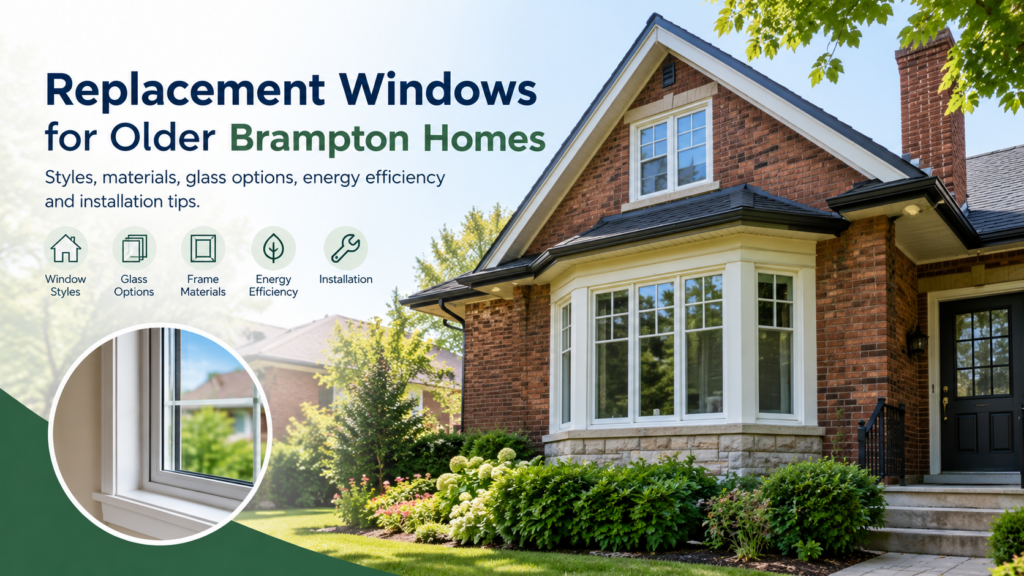
Brampton’s older neighbourhoods carry a lot of history. Whether you live in a brick bungalow off Main Street, a split-level in Bramalea, or a detached two-storey in Heart Lake, these homes were built during an era when window technology, frame construction, and glazing standards were completely different from what exists today. Decades later, many of those original windows — or the replacements that were put in during the 1990s — are starting to show their age.
What makes window replacement in Brampton more complicated in older properties than in newer builds is that nothing is assumed to be standard. Opening sizes can vary from room to room. Previous renovations may have altered the original framing. The frames themselves may have been exposed to years of moisture with no visible evidence on the surface. And on top of the performance considerations, there is the question of appearance — older homes have a particular architectural character, and a window that looks perfectly fine in a modern townhouse can look entirely wrong on a 1960s brick house.
This guide is designed to walk you through the decision from start to finish. We will cover how to assess what you currently have, how to choose the right style and materials for your home’s architecture, what glass and frame options are worth understanding, what questions to ask contractors, and how to avoid the mistakes that turn an otherwise straightforward project into an expensive one.
Why Window Replacement Can Be Different in Older Brampton Homes
If you have ever looked at a window replacement brochure and assumed the process is just a matter of picking a style and booking an installation, older homes have a way of complicating that picture quickly. The reality is that properties built before the mid-1980s were constructed under different standards, with different materials, and often by tradespeople who worked to tolerances that modern manufacturers simply do not design around.
Older homes may have window openings that were framed without the standard rough opening dimensions that today’s window units are manufactured to fit. That means custom sizing is sometimes necessary, or the opening needs to be modified before a standard unit can be installed properly. Either way, it adds a step that newer builds do not require.
Previous renovations complicate things further. A home that had windows replaced in 1994 may have had those units installed in ways that altered the original opening — sometimes squaring it up properly, sometimes creating new problems. If the work was not done well, the current installer inherits those issues.
Older frames have also had significantly more time to be exposed to moisture, temperature cycling, and the kind of gradual deterioration that is not always obvious from the inside of the house. A frame that looks fine from the living room can have significant rot or structural compromise on its exterior face or in the surrounding rough framing. This is something our team checks during every window installation in Brampton before a single product is ordered.
The key point: the right replacement window for an older Brampton home depends on both the product being installed and the condition of the opening it is going into. Getting one right while ignoring the other is how projects go wrong.
Start by Assessing Your Existing Windows
Before you start looking at products or requesting quotes, spend time with your existing windows. A proper inspection before you speak with any contractor puts you in a much better position — you will know what questions to ask, and you will have a clearer sense of what the project actually involves. For a broader overview of warning signs, see our post on the top 7 signs it is time to replace your windows in Brampton.
Frame Condition
On wood frames, work your way around the perimeter and press gently at the corners and along the sill. Softness under pressure, paint bubbling from beneath the surface, or any give in areas that should feel solid all indicate moisture has penetrated and the wood beneath is compromised. On older metal frames — aluminum or steel, both common in Brampton homes from the 1960s and 1970s — look for visible corrosion, broken corner joints, and frames that are pulling away from the surrounding wall or masonry.
Frame condition matters enormously because it determines whether the installation method can be a simpler insert replacement or whether the entire frame and surrounding structure needs to come out before a new window goes in.
Glass Condition
Cracked glass is obvious. Less obvious but equally important is fogging or cloudiness between the panes of a double-glazed unit — this means the sealed perimeter of the insulating glass unit has failed, the gas fill has escaped, and moisture has entered the space between the panes. A foggy window is no longer insulating the way it should. Single-pane glass, which still exists in some of Brampton’s older housing stock, offers almost no meaningful thermal resistance by current standards and should be a priority for replacement. Our article on 10 signs it is time to replace your windows covers glass failure in more detail.
Operation
Work through every window in the house and test them. Do they open smoothly? Do they stay open without a prop? Do the locks engage fully? A window that requires significant force to open or close, or whose hardware has failed to the point where it can no longer be secured, is both a comfort issue and a security concern. For tips on keeping windows secure, see our guide on how to make your Brampton home safer with secure windows and doors.
Water and Air Infiltration
On a cold, windy day, move your hand slowly around the interior perimeter of each window frame. Drafts are easy to locate this way. Then look for water staining on the surrounding drywall or trim — particularly at the corners and along the bottom of the frame — and check the exterior for peeling paint on the trim, gaps in the caulking, or any visible separation between the frame and the surrounding wall surface. Common issues like these are also covered in our post on common window and door problems in Brampton homes.
Inspection checklist before requesting quotes:
- Frame corners and sill — soft spots, rot, or structural movement?
- Glass — fogging between panes, cracking, or single-pane construction?
- Operation — opens, closes, and locks without forcing?
- Drafts — detectable air movement around the frame perimeter?
- Interior water staining on trim or drywall near the window?
- Exterior caulking — cracked, missing, or pulling away from the frame?
- Frame-to-wall connection — visible gaps or movement from outside?
Consider the Architectural Style of Your Older Home
Energy performance and comfort are legitimate reasons to replace windows in an older Brampton home. But performance alone does not justify ignoring how the new windows will look. Windows are one of the most visually prominent features of a house’s exterior, and the wrong choice can change the character of a home in ways that are immediately obvious and very difficult to undo without replacing them again.
Older homes were built with windows proportioned for their architectural style. A mid-century brick bungalow typically had taller, narrower openings. A late-1970s two-storey might have had wide horizontal sliders. A home with traditional exterior detailing — decorative brick coursing, heritage-style trim — probably had windows with colonial grid patterns that contributed to the overall aesthetic. Our guide on how to match window and door styles to your home architecture in Brampton goes into this in detail.
What to consider:
- Proportions: Match the height-to-width ratio of the original opening. Do not change a vertical window to a horizontal one without thinking carefully about what that does to the facade.
- Grid patterns: Colonial grids, prairie-style patterns, and other historical designs can be replicated in modern windows using internal grilles or simulated divided lites without sacrificing the insulating glass unit behind them.
- Frame colour: White works in many contexts, but a brown, bronze, or cream frame may be more appropriate to the home’s period. Look at the original windows or historical photographs if you have them.
- Frame profile width: Slimmer profiles read more modern. Wider profiles can read more traditionally. The profile should be compatible with the scale of the home’s exterior detailing.
You can also browse our modern window and door trends popular in Brampton homes to see what other homeowners in the area are choosing.
Choose the Right Window Style
The operating style of a window — how it opens, how it seals, how it ventilates — should follow from the architecture of the home, the function of the room, and the condition of the existing opening. Our full breakdown of the top 10 window types for Brampton homes is a useful companion to this section.
Casement Windows
Side-hinged, operated by a hand crank, and among the best-sealing windows available because the sash compresses against the frame when closed rather than sliding past it. Casements provide full ventilation across the entire opening and work in most architectural styles. If the original window was a casement, this is almost always the right replacement choice. See our comparison of casement vs. sliding windows if you are weighing both options.
Double-Hung Windows
The traditional operable window of North American residential architecture, with two sashes that slide vertically. Double-hung windows are visually at home in older Brampton properties because they match the proportions and aesthetic that those homes were designed around. If you are unsure whether single-hung or double-hung is right for your home, our guide on single-hung vs. double-hung windows for Brampton homeowners explains the differences clearly. For a deeper look at how these work, read what is a double-hung window.
Sliding Windows
Operate horizontally, with one or both sashes sliding along a track. They work well in openings where a wide, horizontal proportion is already present. However, sliding windows seal less effectively than casements because the sash slides past the frame rather than compressing against it. Our post on casement vs. sliding windows is worth reading before making a final choice.
Awning Windows
Top-hinged, opening outward from the bottom. Useful in bathrooms, kitchens, and basements where ventilation is needed regardless of weather. They can be placed higher on a wall for privacy and are commonly paired below a fixed picture window to add ventilation without altering the visual rhythm of the facade.
Picture Windows
Fixed, non-operable, and available in almost any size. Where the priority is natural light, views, or architectural presence rather than ventilation, a picture window is the most economical way to get a large expanse of glass. Often used in living rooms in older Brampton homes. See our post on 4 window types for maximum daylight for more on using fixed and large-pane windows effectively.
The best approach: match each window to the architecture, ventilation needs, room function, and existing opening dimensions of that specific location rather than choosing one style for the whole house.
Double-Pane vs. Triple-Pane Glass for Older Homes
The glass configuration in a replacement window is one of the most important performance decisions in the project. Our dedicated post on triple-pane vs. double-pane windows covers this topic in full — here is a working summary.
Double-Pane Glass
Two panes of glass with a sealed space between them, typically filled with argon gas. Double-pane units represent the standard replacement option in Ontario and a significant improvement over older single-pane glass and over many of the early double-glazed units installed in the 1980s and 1990s whose seals have since failed. For most older Brampton homes, a quality double-pane unit with Low-E glass will deliver real, noticeable improvements in comfort and draft reduction.
Triple-Pane Glass
Three panes of glass with two sealed, gas-filled cavities. The additional layer provides higher thermal resistance — on a cold February night in Brampton, the interior surface of a triple-pane window will stay noticeably warmer than a double-pane, reducing both drafts and radiant chill near the glass. The trade-offs are weight — triple-pane is substantially heavier, placing more demand on hardware, frame, and rough opening structure — and cost, which is meaningfully higher per window.
When comparing options, look at energy performance ratings, the glass configuration and coatings, the frame construction and its contribution to overall thermal performance, and the full installation requirements. Triple-pane is a strong choice for north-facing or heavily exposed windows. For many replacement projects in older homes, a high-quality double-pane unit remains the more practical choice.
Look at Low-E Glass and Other Energy-Efficient Features
Modern glazing technology has moved well beyond simply putting two panes of glass together. For a thorough look at how these features affect running costs, see our post on whether energy-efficient window glass helps with HVAC costs, and our overview of the benefits of energy-efficient windows.
Low-E coatings are microscopically thin metallic layers applied to one or more glass surfaces. They reflect radiant heat — in winter back into the room, in summer away from the interior. Most quality replacement windows include Low-E glass as standard. Confirm this when comparing quotes.
Gas fills — argon most commonly, krypton in higher-performance units — replace the air in the insulating space between panes. Both gases conduct heat less readily than air, improving the overall thermal performance of the unit.
Multi-chamber frames trap additional air within the frame body itself. A vinyl or fiberglass frame with more internal chambers insulates better than one with fewer. This is an aspect of window construction that rarely gets compared carefully when homeowners are evaluating quotes, even though it meaningfully affects overall performance.
Weatherstripping and modern sealing systems at the sash perimeter are what prevent air infiltration when the window is closed. The quality of the seal varies significantly between product lines and is worth asking about directly. Our post on energy-efficient windows and doors for Brampton homes covers what specifications to look for when comparing products.
An important note: no replacement window will produce a specific, predictable reduction in energy bills. Performance depends on the whole building — insulation levels, air sealing, HVAC efficiency, and the number, size, and orientation of all windows in the home. What a quality replacement window genuinely delivers is improved comfort, reduced drafts, and better temperature consistency near the glass throughout the year.
Think About Brampton’s Seasonal Weather
Brampton sits in Ontario’s zone 6 climate — cold winters that regularly push below –15°C with wind chill, warm and sometimes humid summers, and significant temperature swings in the shoulder seasons. Our post on the best windows for homes in Brampton’s climate goes into detail on how to match product specifications to local conditions. Here is the practical summary.
Winter Considerations
The priority in winter is preventing heat loss and eliminating drafts. A window that seals poorly at the sash perimeter or has failed glazing becomes a cold spot that draws heat away from the room and creates condensation on interior surfaces. If you are replacing windows before the cold season, our guide on why you need new windows before winter explains why timing matters. For help winterising existing windows in the interim, see tips to winterise your windows.
Summer Considerations
Solar heat gain through south and west-facing windows is the summer concern. Low-E coatings with an appropriate solar heat gain coefficient (SHGC) help manage this without significantly reducing natural light. For tips on preparing windows for the warmer months, see four tips to prepare your windows for summer.
Shoulder Seasons
April and October are when operable windows actually get used — when the weather is good enough to open the house but not yet reliably warm or cool enough to rely on the HVAC. Smooth, reliable operation across all four seasons should be part of what you are evaluating, not just thermal performance in winter. For advice on the best time of year to schedule the actual replacement work, read what is the best time of year to replace windows in Brampton.
Replacement Window Frame Materials: What Should You Consider?
Frame material affects how a window performs thermally, how it looks on the house, and how much maintenance it requires over the years. Our comparison of vinyl vs. wood windows for Brampton homes and vinyl vs. aluminum windows for energy efficiency are both useful reads before making a final decision.
Vinyl
The dominant frame material in the Canadian replacement window market. Vinyl frames do not rot, do not need painting, handle Ontario’s freeze-thaw cycles well, and are available across a wide range of profiles, colours, and price points. Better-quality vinyl windows use multi-chamber frame construction that meaningfully improves thermal performance. A well-manufactured vinyl window with appropriate proportions and colour is visually suitable for most older Brampton homes and requires essentially no maintenance beyond occasional cleaning. See our post on vinyl vs. aluminum windows for a direct comparison.
Fiberglass
Dimensionally stable — fiberglass expands and contracts at approximately the same rate as glass, which reduces long-term stress on the glazing seals. It is stronger than vinyl, available in slimmer profiles in some product lines, and can be painted if colour changes are needed later. Fiberglass windows cost more and are available from fewer suppliers in the Ontario market, but for homeowners who want a particularly durable, long-lasting product, they are worth including in the comparison.
Aluminum
Strong and available in slimmer profiles than vinyl, which can be suitable for applications where sightlines matter. The limitation is thermal performance — aluminum conducts heat readily, which means frames without a proper thermal break will cause condensation and cold spots in Ontario winters. Our post on vinyl vs. aluminum windows for energy efficiency explains this trade-off in detail.
Wood
The original frame material in many of Brampton’s older homes, and still the most architecturally compatible choice in character-sensitive renovations. Real wood frames require regular maintenance — painting or staining on a routine cycle — and are vulnerable to moisture if that maintenance is neglected. Wood-clad windows, which have a vinyl or aluminum exterior cladding over a wood interior, reduce the maintenance burden while preserving the wood appearance inside. Our detailed comparison of vinyl vs. wood windows is worth reading before making a final call on material.
Should You Preserve the Original Look?
For many homeowners with older Brampton properties, this is the question that drives the entire project. They want the drafts gone and the energy performance improved — but they do not want to look at their house from the street and feel like something has been lost.
The reassuring answer is that modern replacement windows can preserve the look of an older home when the selection process is handled properly. Our post on matching window and door styles to your home’s architecture in Brampton is the right starting point for this conversation.
Matching proportions is the single most important factor. A window that fills the same opening in the same height-to-width ratio will read correctly on the facade even if everything else about it is new.
Replicating grid patterns through internal grilles, between-glass grilles, or simulated divided lites gives modern windows the visual subdivision of the original single-pane or divided-light units without compromising the sealed insulating glass unit.
Choosing appropriate frame colours — rather than defaulting to white — can be the difference between a replacement that looks right and one that looks like a replacement. You can browse our project portfolio to see how different frame colours and styles look on real Brampton homes.
Maintaining symmetry across the facade matters too. If all windows on the front of the house have always been the same style and grid pattern, mixing styles across the replacement project will be visible and look unintentional. Modern performance with traditional appearance is achievable — it requires attention during selection, not compromise on either side.
Measurements Matter More in Older Homes
This is one of the places where older homes genuinely differ from new construction in a way that has practical consequences. In a newly built home, rough openings are framed to standard dimensions and are reliably square. In a home built in 1962 or 1975, that consistency may not exist — and even if it did originally, decades of settling, past repairs, and previous renovations may have changed things.
Never assume that because two windows look the same size from inside the room, they can be replaced with the same unit. Measure every opening individually before ordering anything. Professional measurement should account for width and height at multiple points, the depth of the frame and wall, the squareness of the opening corners, the condition and composition of the surrounding frame material, and any obstructions that will affect installation.
Incorrect measurements create installation problems that are expensive to fix. Professional measurement before ordering is not an optional step in a project like this. It is part of what our window installation service in Brampton includes as a matter of course before any product is ordered.
Replacement Windows vs. Full-Frame Window Replacement
This distinction is one of the most important in the whole project, and it is worth understanding clearly before any contractor makes a recommendation. For a general overview of what the replacement process involves, see our complete homeowner’s guide to replacing windows and doors.
Replacement/Insert Approach
A replacement or pocket installation involves removing the existing sash, hardware, and glazing while leaving the existing frame in place. The new window unit is installed within that existing frame. This approach is less disruptive — interior trim and exterior cladding typically stay in place, the installation is faster, and there is less mess. It is a practical choice when the existing frame is structurally sound, properly secured, and free of significant moisture damage.
Full-Frame Replacement
A full-frame replacement removes everything — sash, hardware, frame, and associated interior and exterior trim — down to the rough opening. This allows the installer to fully inspect the surrounding framing, address any moisture damage or structural issues before the new window is installed, and potentially modify the opening size if needed. It is the appropriate method when the existing frame is deteriorated, when moisture damage is suspected, or when the opening needs to be modified.
Neither approach is universally better. The appropriate method depends on the condition of the existing frame, the construction of the surrounding wall, the project goals, and the specific product being installed. A contractor who recommends one approach before inspecting the existing frame has not done enough due diligence. The inspection should come first — the method recommendation should follow from what is found. Our guide on DIY vs. professional window installation also covers why professional assessment matters at this stage.
Watch for Moisture and Structural Problems
Older Brampton homes can carry decades of quiet water infiltration around window openings, and the evidence is not always on the surface. Masonry absorbs moisture slowly and releases it slowly. Wood framing wicks water and holds it. By the time you see a visible sign, the problem behind the wall may be substantially more developed than the surface suggests.
Signs worth taking seriously before any replacement work begins:
- Soft or deteriorated wood around the frame perimeter
- Water staining on interior trim, drywall, or window casings
- Interior paint peeling near window corners without obvious cause
- Any visible mold-like growth on surfaces near the window
- Persistent condensation on interior surfaces during winter months
- Damaged or deteriorated exterior trim that has allowed water behind the cladding
- Gaps between the frame and surrounding masonry or siding
If any of these conditions are present, a full-frame replacement is almost certainly the right approach — and the scope of work needs to include addressing the underlying moisture issue, not just covering the opening with a new window. Our post on protecting your Brampton home from storm damage also covers how water intrusion around windows and doors can lead to larger structural problems if left unresolved.
Consider Egress Requirements for Basement and Bedroom Windows
If you are replacing windows in a basement bedroom, or considering creating a bedroom space in a basement that currently has windows that are too small, Ontario’s building code sets minimum requirements for the opening size of those windows. The intent is to ensure that an occupant can escape and that emergency services can access the space in the event of a fire.
Our post on the legal requirements for bedroom and basement windows explains what the Ontario code specifies and what triggers a permit requirement. Do not rely on generic measurements from an online article for this — confirm the applicable requirements directly with your contractor or with the City of Brampton’s building department before ordering windows for any sleeping area. A window that does not meet egress requirements in a bedroom is both a building code issue and, more importantly, a safety issue for the people sleeping in that room.
How to Compare Window Replacement Quotes
Window replacement quotes from different companies frequently look like they are comparing the same thing when in reality they are comparing very different scopes of work. Before you review any quotes, our post on 10 things to know before replacing your windows and doors is a worthwhile read. And our guide on what to expect from window installation costs in Brampton will help you understand whether the numbers you are seeing are reasonable.
When evaluating quotes, confirm that each one covers:
- Window brand and specific product line
- Frame material and construction details
- Glass configuration — pane count, Low-E coating, gas fill
- Energy performance specifications
- Number of windows included
- Installation method — insert or full-frame
- Removal and disposal of existing windows
- Exterior finishing — caulking, trim, flashing
- Interior finishing — trim, casing, paint preparation
- Product warranty — what it covers and for how long
- Installation warranty — what it covers and for how long
- Cleanup on completion
- Any additional repairs identified — and how they are priced
A lower quote is not necessarily better value. A quote that is $600 less than another may exclude disposal of the old windows, interior finishing, or any repairs found during installation. Get those details in writing before making a decision. You can also check our current specials to see whether any promotions apply to your project.
Questions to Ask a Brampton Window Contractor
Beyond the quote itself, the conversation with a contractor before you commit tells you a great deal about how the project will actually be handled. Our post on questions to ask before buying new windows in Brampton is a full guide — here are the essentials:
- What type of replacement window do you recommend for this home — and specifically why?
- Will you inspect the existing frames before recommending an installation method?
- What will you look for during that inspection?
- What installation method are you proposing, and what would change that recommendation?
- Will you check the surrounding framing for moisture or structural damage?
- What glass configuration are you proposing, and what are the energy performance specifications?
- What frame material and construction are you proposing?
- Is removal and disposal of the existing windows included?
- Does the quote include both interior and exterior finishing?
- What happens if damage is found after the existing window is removed?
- What does the product warranty cover, and what does the installation warranty cover?
- Are you licensed and insured to perform this work in Ontario?
For further guidance on choosing the right company, see our post on how to choose the right window installer in Brampton and our overview of considerations when choosing a window replacement company.
Common Mistakes Homeowners Should Avoid
Choosing based only on appearance. The way a window looks in a showroom tells you very little about how it will perform on a north-facing wall in January or how well it will seal over time. Performance and installation quality matter as much as aesthetics.
Choosing the cheapest quote without comparing scope. The cheapest quote is often the cheapest because it covers less. A quote that excludes finishing, disposal, or repairs will add those costs later — usually at a higher per-item price than if they had been included from the start. Our post on affordable window and door replacement ideas for Brampton homes shows how to get better value without cutting corners on quality.
Ignoring the condition of existing frames. Installing a new window into a deteriorated or moisture-compromised frame is one of the most reliable ways to end up with a window that performs poorly and fails prematurely. The frame inspection is not optional.
Assuming every window opening should use the same style. Different rooms have different ventilation requirements. Different wall orientations have different solar exposure. One style does not suit every opening in every home.
Ignoring glass performance. The frame gets a lot of attention during selection. The glass configuration — pane count, Low-E coatings, gas fill, SHGC rating — often gets much less, even though it determines most of the thermal performance.
Forgetting about ventilation needs. A window chosen purely for appearance or glass performance may be non-operable or poorly positioned for actual airflow. Our post on how to choose the best windows and doors for your home covers ventilation planning as part of the selection process.
Failing to consider the home’s architectural character. Windows that look out of place on the exterior of an older home reduce its appearance and potentially its resale value. Our post on window and door renovations that pay off for Brampton homes and whether replacing windows increases home value are both worth reading if resale is part of your thinking.
Not asking what the installation warranty actually covers. Product warranties and installation warranties are different documents. A product warranty that does not cover the installation means a leak at the frame perimeter a year later may fall outside the coverage you assumed you had. Review our warranty page to understand what our coverage includes.
A Simple Checklist for Choosing Replacement Windows
Before ordering anything:
- Inspect all existing windows using the checklist from Section 2
- Check for signs of moisture or structural issues around each opening
- Identify the home’s architectural style and what window characteristics define it
- Decide which rooms and openings require operable windows for ventilation
- Compare window styles against the architecture and ventilation requirements of each location — see our top 10 window types guide
- Compare frame material options — see vinyl vs. wood and vinyl vs. aluminum
- Compare double-pane and triple-pane options — see our full comparison
- Review energy performance specifications — not just R-value, but SHGC and air infiltration ratings
- Have every opening professionally measured before ordering
- Request multiple detailed written quotes covering the same full scope
- Review both product and installation warranties before signing — see our warranty page
- Confirm egress requirements for any bedroom or basement windows — see legal requirements guide
When Is It Time to Replace Rather Than Repair?
Not every window problem requires full replacement. Our post on common window problems and how to fix them covers the situations where repair is the right answer. And our post on reasons to replace the windows of your home is the companion read when the problems have moved beyond what repair can address.
Consider replacement when:
- The same problems keep recurring despite previous repairs
- The frame is significantly deteriorated and can no longer be properly restored
- The window no longer operates correctly and repair costs are disproportionate
- Seals have failed and the window is no longer thermally performing
- Persistent drafts continue despite attempts to seal or weatherstrip
- Moisture problems continue to recur around the opening
- The existing window design no longer suits the renovation goals for the home
Consider repair when:
- The underlying window structure is still in sound condition
- The problem is limited to hardware, weatherstripping, caulking, or another genuinely repairable component
- The cost of repair is proportionate to the remaining useful life of the window
- Replacement would not provide meaningful additional value for the specific problem being addressed
A contractor who recommends full replacement without considering whether repair is appropriate has not served you well. The right answer depends on an honest assessment of what is actually there. Our post on signs that it is time to replace your home windows can help you make this call with more confidence.
Final Takeaway: Choosing Windows for an Older Brampton Home
Replacing windows in an older Brampton home is a significant project, and the decisions made during the planning process will determine whether the outcome is one you are satisfied with for the next two or three decades. The core factors to carry through every decision are:
- The condition of the existing windows and frames — this drives the installation method
- The architectural style of the home — this drives style, proportions, and frame appearance
- Glass performance — pane count, coatings, and gas fill all affect real-world comfort
- Frame material — matched to the home’s style, maintenance expectations, and the climate
- Ventilation requirements — different for every room and every opening
- Installation method — insert or full-frame, determined by frame condition
- Warranty — product and installation, read separately and understood before signing
- Project scope — confirmed in writing before work begins
The right next step is an on-site assessment of your existing windows. If you are in Brampton or the surrounding GTA, contact Advance Windows to arrange a free assessment. You can also explore our full window replacement service in Brampton, our window installation service, and our windows and doors Mississauga page if you are in the broader GTA area. View real completed projects in our portfolio and check our current specials before you book.
Frequently Asked Questions
What type of replacement windows are best for older homes in Brampton?
There is no single answer. The appropriate window depends on the home’s architectural style, the condition of the existing opening, the ventilation requirements of each room, and the performance characteristics that matter most. In most cases, a casement or double-hung window in a quality vinyl frame with a Low-E, argon-filled double-pane unit will be appropriate. Where architectural character is the priority, wood-clad or fiberglass options may be worth considering. A proper site assessment should drive the recommendation. See our Brampton window installation service and our full guide to the best windows for Brampton’s climate.
Should I choose double-pane or triple-pane windows for an older home?
For most replacement projects in older Brampton homes, a high-quality double-pane unit with Low-E glass and an argon fill will deliver real, meaningful improvements. Triple-pane is worth a closer look for north-facing or significantly exposed openings, or where the budget supports it. Triple-pane units are substantially heavier, which places greater demands on hardware, frames, and the rough opening structure — particularly relevant in older homes. Read our full comparison: triple-pane vs. double-pane windows.
Can replacement windows maintain the original look of an older home?
Yes, when the selection process accounts for the architectural character of the home. Modern replacement windows can be ordered with grid patterns that replicate original layouts, in frame colours appropriate to the home’s period, and in proportions that preserve the visual rhythm of the facade. See: matching window and door styles to your home’s architecture in Brampton and browse our completed project portfolio.
How do I know if my old window frames need to be replaced entirely?
The main indicators are physical deterioration in the frame — softness, rot, or structural movement in wood frames; corrosion and failed corner joints in older metal frames — and the presence of moisture damage in the surrounding wall framing. If the existing frame is structurally sound, a pocket installation is often appropriate. If there is any doubt, a full-frame replacement is the safer choice. Our Brampton window replacement process includes a frame inspection before any method is recommended. Also see: 7 signs you need window replacement in Brampton before winter.
How long does window replacement take in an older Brampton home?
A typical project replacing several windows usually takes one to two installation days. Variables include the number of windows, the installation method, accessibility, and whether repairs to the surrounding framing are required. Windows are measured on-site and ordered, which typically involves a lead time of several weeks. The measurement appointment and installation are separate visits. For timing advice, see the best time of year to replace windows in Brampton.
Should I replace all the windows at once?
Replacing all windows at once has practical advantages: the disruption happens once, the project can often be negotiated at a better overall price, and the home ends up with consistent performance and appearance throughout. Staged replacement is a reasonable approach when budget requires it. Windows that are most deteriorated or in rooms with safety concerns — basement bedrooms with egress issues, for example — are generally the right ones to address first. Our post on window and door renovations that pay off for Brampton homes can help you prioritise by ROI.
What should I ask before hiring a window replacement company?
Ask specifically how they will determine the installation method, what is included in the quoted price, what the product and installation warranties each cover, and how they handle unexpected damage found after the existing window is removed. A trustworthy contractor answers these questions in writing as part of the quote. For a full checklist, read: questions to ask before buying new windows in Brampton, how to choose the right window installer in Brampton, and considerations when choosing a window replacement company.